Blokz Journal / SEC / Fintech
Fintech Clearing Firm AtlasClear: Stock Locate Fees Reach $6.8M
AbstractAtlasClear's 8-K reports preliminary fiscal 2026 revenue up 85% to $20.1 million, led by stock locate fees, with net income and no dilutive raise since 2025.
KeywordsFintech; Broker-Dealers; Clearing; SEC Filings
Filing data
| Form | Company | Items | Accession | CIK |
|---|---|---|---|---|
| 8-K | AtlasClear Holdings, Inc. | — | 0001493152-26-043918 | 1963088 |
Clearing firms rarely draw attention outside the trading industry. They sit behind the brokers that face customers, settling trades, holding assets and meeting capital requirements that most investors never see. A Form 8-K that AtlasClear Holdings filed in September 2026, attaching a press release dated September 17, gives an unusually detailed look at how one small clearing business is trying to grow, and at the capital rules that shape its choices. The company, which trades on NYSE American as ATCH and is based in Tampa, describes itself as building regulated financial infrastructure for smaller institutions, fintechs and advisors. Its pitch leans on fintech, but the numbers are about brokerage.
The preliminary results
The release gives preliminary, unaudited figures for the fiscal year ended June 30, 2026. Total revenue is expected to be about $20.1 million, up roughly 85% from $10.9 million in fiscal 2025. Interest income of about $1.8 million, which GAAP presents in other income, brings revenue plus interest income to about $21.9 million, against about $12.9 million a year earlier, an increase of about 70%. The release notes that audited financial statements for the company’s broker-dealer subsidiary, AtlasClearing, Inc., filed with the SEC on August 31, 2026, present interest income inside revenue and show total revenues of approximately $21.8 million. The two figures differ because of that presentation, not because of different underlying activity.
Profitability is described carefully. The company expects net income of about $2.0 million, its second consecutive profitable year, and acknowledges that the result includes non-cash gains from changes in the fair value of its financial instruments. Cash and cash equivalents are expected to be about $15.4 million, more than double the $7.5 million a year earlier. Stockholders’ equity is about $21.1 million, compared with a deficit of about $6.8 million at June 30, 2025. Total liabilities are about $50.1 million, a reduction of roughly $17.6 million.
The release labels revenue plus interest income as a non-GAAP measure and says it should not substitute for GAAP revenue. All of the figures are subject to completion of the closing process and audit, and the company warns that final results could differ materially.
Where the growth came from
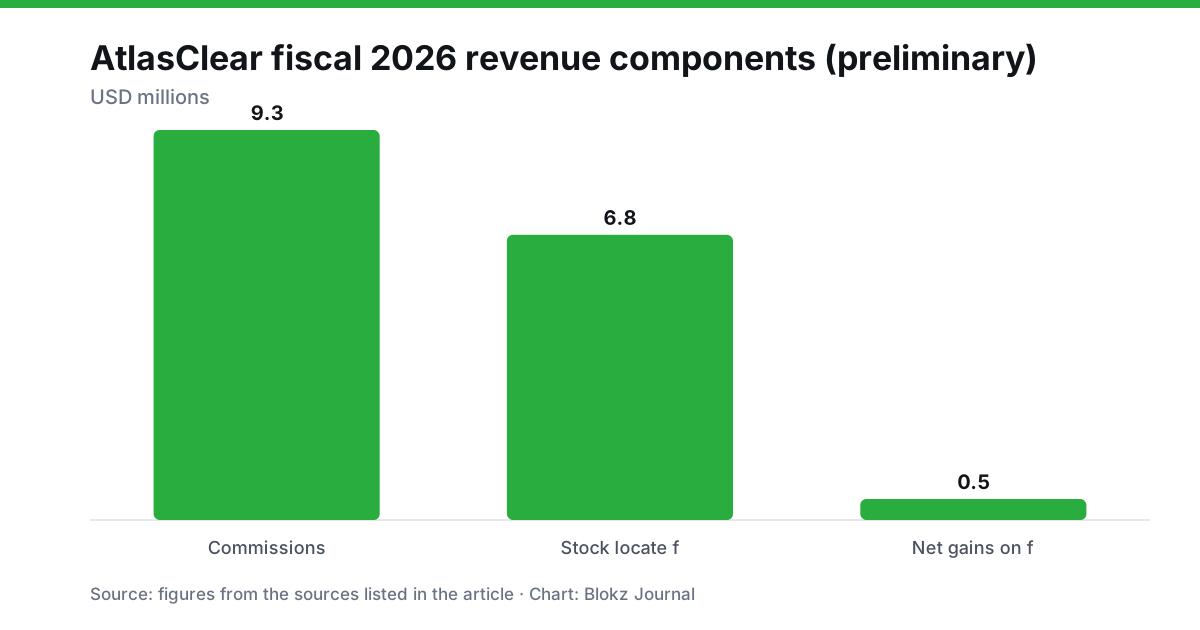
Commission revenue rose about 56% to about $9.3 million. The larger story is stock locate fees, a business the company launched and scaled during the year, which grew to about $6.8 million from about $0.3 million and represented about 34% of total revenue. Net gains on firm trading accounts added about $0.5 million.
A stock locate fee is charged when a broker-dealer arranges for shares to be located and available to borrow before a customer sells them short. Federal short-sale rules require a broker-dealer to have reasonable grounds to believe that securities can be borrowed before it accepts a short sale order. The company bills for that service, so the fee income is tied to short-selling activity on the platform, which can change quickly.
The shift in mix is large. Commissions fell from about 55% of revenue in fiscal 2025 to about 46% in fiscal 2026, so non-commission lines now account for about 54%, up from 45%. A business whose revenue depends on one line, such as commissions, is exposed to changes in trading volumes, and the company is presenting diversification as a result. The same dependence now applies to stock locate, which provides a third of revenue after a single year.
The capital rules in the background
The passage on net capital is the most useful part of the release for readers outside the industry. AtlasClearing’s net capital rose to about $14.4 million at June 30, 2026 from $11.2 million a year earlier, according to its audited annual report. That is about $14.1 million above its minimum requirement and above the $10 million excess net capital threshold that the National Securities Clearing Corporation requires of firms that clear for introducing brokers.
The release adds a qualification that shows how fast-growing revenue can complicate the regulatory ratio. Net capital is stated after deducting unsecured receivables from other broker-dealers for stock locate fees, which are treated as non-allowable assets until they are collected. Those receivables have grown with the stock locate business. In plain terms, revenue that has been earned but not yet paid does not count toward regulatory capital, so growth in this line temporarily holds net capital down.
Net capital is the regulatory measure of a broker-dealer’s liquid resources, and clearing firms are held to it more closely than introducing brokers because they stand behind their correspondents’ trades. For AtlasClearing, a margin of about $14.1 million over the minimum is the cushion that lets it take on new correspondents, which in turn is the growth the company is highlighting. The cushion is also the number that would tighten if receivables from other broker-dealers keep growing faster than collections.
A pipeline, and a financing claim
AtlasClearing has signed clearing agreements with six new correspondent broker-dealers that are in various stages of onboarding and conversion. Fiscal 2026 results contain no meaningful revenue from them, and the company expects contributions to begin as conversions finish during fiscal 2027. Management said the added customer assets and trading activity would let it scale stock loan and add forms of interest income, including on margin balances, customer cash and securities lending.
The company also made a statement about its capital-raising. It says fiscal 2026 growth was achieved without at-the-market or equity line financing, that it sold no shares under its equity line facility during the year, and that it has conducted no at-the-market offering or other dilutive raise since an institutional unit financing in October 2025. Shares outstanding were about 150.3 million at June 30 and about 151.8 million as of the release date. The difference is about 1.5 million shares.
What to watch
Two follow-ups are scheduled. The company said it expects to file its annual report on Form 10-K and report full-year results by September 28, 2026, and to hold a conference call by the same date. Those documents will replace the preliminary numbers with audited ones. The release also refers to a bank strategy, including a planned acquisition of Commercial Bancorp of Wyoming, for which the company says it intends to refile its application. The deal would add a commercial bank to the brokerage platform. That transaction would be subject to its own regulatory process, and the 10-K should show how it is progressing.
References
Prepared with AI assistance from the documents in the references and reviewed under our editorial policy. Not investment advice.