Blokz Journal / SEC / Stablecoins
Stablecoin Regulation and Circle's Q3 8-K: USDC Holds at $73.9B
AbstractCircle's Nov. 4 8-K shows USDC flat at $73.9B, a $182M ARC token presale and a Tazapay deal, with the GENIUS Act still shaping how it describes USDC's status.
KeywordsStablecoins; SEC Filings; Digital Assets
Filing data
| Form | Company | Items | Accession | CIK |
|---|---|---|---|---|
| 8-K | Circle Internet Group | 2.02 | 0001876042-26-000309 | 1876042 |
Circle Internet Group furnished a Form 8-K on November 4, 2026, attaching its third-quarter results as Exhibit 99.1. The filing is an Item 2.02 report, which means the press release is furnished rather than “filed” for purposes of Section 18 of the Exchange Act. Read closely, though, the exhibit is more than an earnings summary. It is a snapshot of a stablecoin issuer that is growing its revenue without growing its core product, and of a company that still describes its regulatory footing in conditional terms. For readers who follow stablecoin regulation, the risk language in the document is as informative as the income statement.
Key takeaways
- Average USDC in circulation was $73.3 billion, up 8% from a year earlier, while the end-of-period figure of $73.9 billion was unchanged year over year.
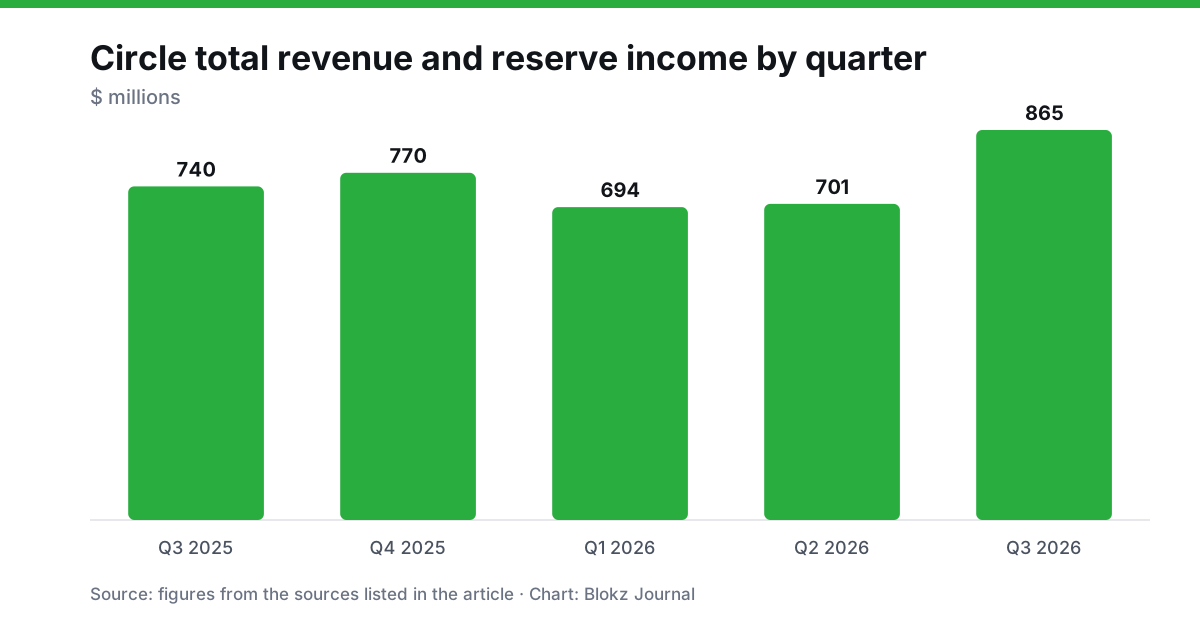
- Total revenue and reserve income reached $865 million, up 17%. Reserve income fell 8% to $658 million, and the gain came from $207 million of other revenue, including $182 million from an ARC token presale.
- Net income from continuing operations was $226 million, up 5%. Adjusted EBITDA was $317 million, up 85%.
- Circle signed a definitive agreement to acquire Tazapay, with closing expected in 2027 pending regulatory approvals.
- The release says that, until amendments in the GENIUS Act take effect, Circle continues to rely on its own conclusion that USDC is not a security.
What the quarter looked like
The headline figures are straightforward. Circle reported total revenue and reserve income of $865 million for the quarter ended September 30, 2026, compared with $740 million a year earlier. The company’s quarterly table shows the four prior quarters at $740 million, $770 million, $694 million and $701 million, so this quarter’s $865 million is the highest in the five-quarter series by a wide margin.
The composition matters more than the total. Reserve income, the interest earned on assets backing USDC, was $658 million, down from $711 million. The release attributes the decline mainly to a 61 basis point drop in the reserve return rate, which stood at 3.5%, partly offset by the 8% rise in average USDC outstanding. Other revenue was $207 million against $28.5 million a year earlier, and the release says the increase came from the ARC token presale ($182 million), partly offset by lower subscription and services revenue.
That presale revenue also explains why adjusted EBITDA rose 85% to $317 million while net income from continuing operations rose only 5% to $226 million. Circle’s own explanation for the EBITDA jump cites the ARC presale revenue and lower distribution costs, partly offset by higher spending on new products. Distribution, transaction and other costs were $412 million, down 8%, mostly because of lower distribution payments. Revenue less distribution costs came to $453 million, a 52% margin.
For nine months, the income statement shows net income from continuing operations of $329.5 million, against a loss of $202.9 million in the same period of 2025. Compensation expense for the nine months was $396.3 million, compared with $708.3 million a year earlier.
A flat circulation figure and a falling market share
The operating indicators tell a more cautious story than the revenue line. USDC in circulation at the end of the period was $73.9 billion, a 0% change from a year earlier. USDC minted in the quarter was $104 billion, up 31%, and USDC redeemed was also $104 billion, up 54%. Circle’s stablecoin market share at period end was 27%, down 183 basis points, using a definition in the release that covers U.S. dollar fiat-backed stablecoins above $100 million in circulation with periodic public attestations.
Activity, by contrast, grew. USDC onchain transaction volume was $13.9 trillion, up 49%. USDC held on Circle’s platform at the end of the period was $13.9 billion, up 36%, and meaningful wallets, defined as onchain wallets holding more than $10 of USDC, reached 7.3 million, up 16%. Circle’s guidance table leaves a multi-year through-cycle USDC circulation growth target of 40% a year unchanged, along with full-year 2026 other revenue of $310 million to $330 million, a revenue-less-distribution-costs margin of 41.7% to 43.7%, and adjusted operating expenses of $570 million to $585 million. The release notes that the first two ranges include recognized ARC presale revenue.
The balance sheet behind the reserves
The condensed balance sheet shows how much of Circle’s footprint is customer money. Cash and cash equivalents segregated for the benefit of stablecoin holders were $73.57 billion at September 30, against $75.07 billion at year-end 2025, while deposits from stablecoin holders were $73.45 billion, against $74.91 billion. Total assets were $77.7 billion. Circle’s own unrestricted cash and equivalents were $1.70 billion, up from $1.53 billion, and total stockholders’ equity was $3.86 billion. Convertible debt, which stood at $36.8 million at year-end, was nil.
Arc, the ARC token and the securities question
The business section describes the September 16 launch of the Arc public mainnet and the genesis mint of 10 billion ARC tokens. The release says this made Circle the first publicly traded company to mint a network token for a new layer-one blockchain, and that Arc is working toward a transition to proof of stake in 2027. It also reports $182 million of presale revenue recognized in the quarter.
The forward-looking statements section is where the regulatory framing sits. It says the GENIUS Act will change the payment stablecoin ecosystem in ways that cannot yet be known. It also says the act amends the federal securities laws to exclude payment stablecoins issued by permitted payment stablecoin issuers, a category the release says will include USDC, but that until those amendments are effective Circle will continue to rely on its conclusion that USDC is not a security. That is a company-level legal position stated in a disclosure document, not a regulatory determination, and the release presents it as such.
Arc and the ARC token carry their own warnings. The release lists legal, regulatory and structural risk, including uncertainty under securities and other financial regulatory regimes, risks from token presale and distribution arrangements, and possible repayment obligations if key launch milestones are not achieved. The document does not elaborate on those repayment terms, so the exhibit alone does not allow a reader to size them.
Deals and partnerships
Circle signed a definitive agreement to acquire Tazapay, a Singapore-headquartered business-to-business cross-border payments platform. The release says Tazapay brings more than $25 billion in annualized payment volume, more than 60 banking and fintech partners and payout rails covering over 100 markets, with about 60% of its volume already involving stablecoins. Closing is expected in 2027, pending regulatory approvals. Circle also reported that its Circle Payments Network reached $41.3 billion in annualized total payment volume.
Other items in the release include a $100 million equity investment by Binance alongside an expanded and renewed partnership to promote USDC, a principal partnership with Chelsea FC beginning with the 2026/27 season, and integrations or partnerships involving Samsung Wallet, Visa Direct’s stablecoin prefunding, Tereina, Allaria and Volante Technologies. Apart from the size of the Binance investment, the release describes each in a sentence or two without financial terms.
Why the filing matters
Three things stand out for a reader tracking digital asset rules. First, Circle’s revenue growth in the quarter leaned on a token presale rather than on the reserve income that has defined the business, and the exhibit is explicit about that split. Second, the company’s description of USDC’s status under the securities laws is tied to the effective date of statutory amendments, which makes the timing of the GENIUS Act’s provisions a live variable in how the company talks about itself. Third, the risk language around ARC shows an issuer of a regulated stablecoin also taking on the disclosure burden of a network token.
The call to discuss results was set for 8 a.m. ET on the same day, hosted through Circle’s channels on YouTube and X. Circle also states that it uses its investor relations site, blog, press room and social channels to disclose material information under Regulation FD, so the 8-K is one of several places where the company communicates with investors.
References
- Circle Internet Group, Form 8-K and Exhibit 99.1, Nov. 4, 2026, sec.gov.0001876042-26-000309
- Circle Internet Group, Form 8-K (Item 2.02), sec.gov.
Prepared with AI assistance from the documents in the references and reviewed under our editorial policy. Not investment advice.