Blokz Journal / SEC / Crypto 8-K
Crypto 8-K: Core Scientific's AI Colocation Shift and a $1.2B Loss
AbstractA crypto 8-K from Core Scientific shows colocation revenue up sharply in Q2 2026 while warrant fair-value changes pushed the net loss past $1.15 billion.
KeywordsCrypto 8-K; Bitcoin Mining; Earnings; Digital Assets
Filing data
| Form | Company | Items | Accession | CIK |
|---|---|---|---|---|
| 8-K | Core Scientific, Inc. | — | 0001839341-26-000013 | 1839341 |
A company that built its name mining bitcoin now describes itself, in its own securities filings, as a builder of data centers for artificial intelligence workloads. The Form 8-K that Core Scientific filed on July 28, 2026 is a useful example of why a crypto 8-K search no longer returns only crypto companies, and why the label on the filer says less than the numbers do. The filing attaches the company’s second-quarter results as Exhibit 99.1, and the phrase “digital assets” appears in it mainly as a line in the liquidity definition and as a minor source of revenue.
For readers who track digital-asset disclosures, the document is worth reading closely. It shows what happens to the reporting of a former mining company when most of its revenue and nearly all of its growth come from selling power and space to other businesses.
What the second-quarter numbers show
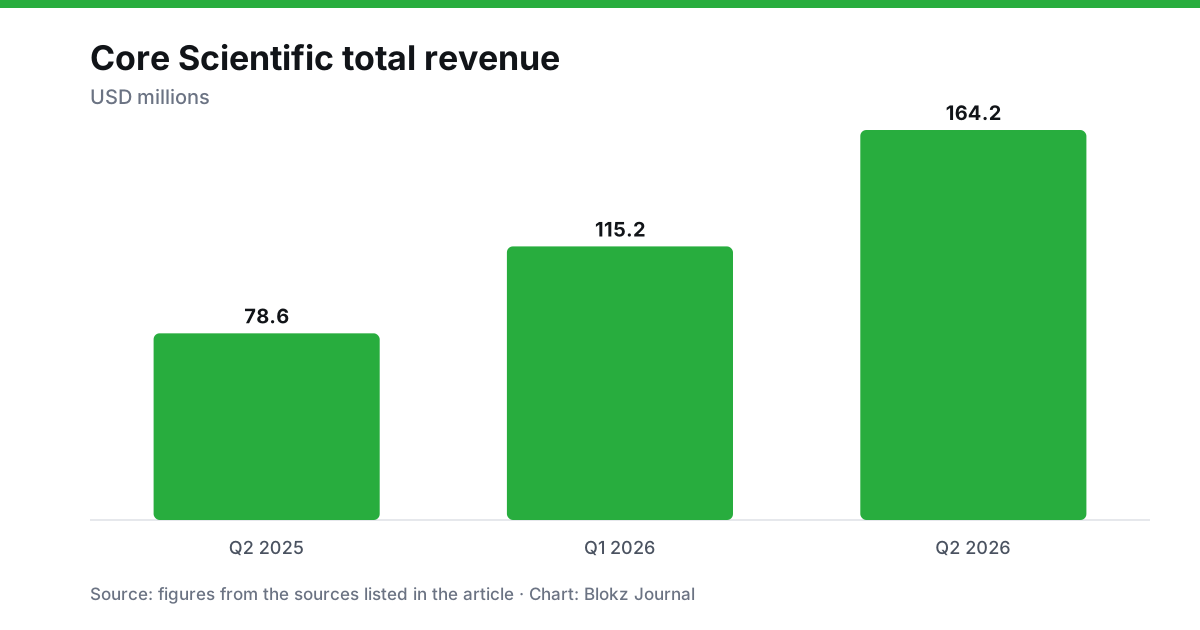
Core Scientific, which trades on Nasdaq under the symbol CORZ and datelined its release from Miami, reported total revenue of $164.2 million for the quarter ended June 30, 2026. That compares with $115.2 million in the first quarter and $78.6 million in the second quarter of 2025. The driver was high-density colocation, the service of hosting customers’ computing equipment in purpose-built facilities. Colocation revenue reached $136.7 million, up from $77.5 million in the first quarter and $10.6 million a year earlier.
The operating metrics moved in the same direction. Billing capacity averaged 395 megawatts in the quarter, against 225 megawatts in the first quarter. Gross profit rose to $70.0 million from $30.1 million, and adjusted EBITDA, a non-GAAP measure, came in at $41.1 million, compared with $8.9 million in the prior quarter. The company said it was billing for 437 megawatts as of mid-July, which it equated to roughly $635 million in average annualized colocation revenue under GAAP.
Capital spending is the other side of that growth. Core Scientific spent $797.5 million on property, plant and equipment and on acquisitions of land and development rights during the quarter, roughly double the $389.2 million it spent in the first quarter. Liquidity, which the company defines as cash and cash equivalents plus digital assets, stood at $1,819.4 million, up from $1,042.5 million at the end of March.
A $1.15 billion loss that is not an operating loss
The headline figure that will draw the most attention is the net loss of $1,155.3 million, against $347.2 million in the first quarter and $936.8 million in the second quarter of 2025. A loss of that size next to $41.1 million of adjusted EBITDA looks contradictory until the footnote is read. The company attributed the quarter’s loss primarily to the change in fair value of its warrants, which it said reflected appreciation in its stock price during the period.
This is a mechanical feature of warrant accounting. When warrants are classified as liabilities and measured at fair value, a rising share price increases the liability and runs the increase through the income statement as a loss. The loss is real in the sense that it reduces reported net income, but it does not represent cash leaving the business. The same pattern appears in the year-earlier quarter, where the net loss was $936.8 million while revenue was only $78.6 million. Readers comparing quarters should look at the fair-value line separately from gross profit and EBITDA.
The point for analysts is that the loss tracks the share price, not the economics of the colocation contracts. The release’s income statement itemizes the charge: the change in fair value of warrants and contingent value rights was $1,045.5 million for the quarter, against $910.0 million in the year-earlier quarter.
Contracts, not coins
The business developments listed in the release help explain the rise in the share price that drove the warrant charge. Core Scientific announced a partnership with AMD that it said could support up to 2.5 gigawatts of leasable capacity, anchored by 15-year agreements covering about 530 megawatts across five sites and more than $14 billion of potential base contracted revenue. Total leased customer power capacity rose to approximately 1.1 gigawatts, which the company put at more than $24 billion of potential contracted revenue.
The word “potential” matters. Contracted revenue figures describe what customers have agreed to pay over the life of agreements if the facilities are built, energized and accepted on schedule. The forward-looking statements section of the release lists the dependencies directly: financing and completing construction, sourcing enough electrical power, obtaining long-lead infrastructure equipment, and acquiring additional land and power. Each of those is a risk that sits in the construction pipeline, not in the crypto market.
The company’s own description of itself has shifted accordingly. It says the majority of its revenue comes from high-density colocation, with the remainder from earning digital assets for its own account and from hosting digital-asset mining for third parties. It also says it is repurposing its remaining mining facilities to support colocation “as circumstances allow.” The facilities it lists span Alabama, Georgia, Kentucky, North Carolina, North Dakota, Oklahoma and Texas.
What it means for digital-asset disclosure
Securities lawyers and compliance staff who screen filings for digital-asset exposure will find this document instructive in a narrow way. Core Scientific’s results are not a data point about bitcoin prices, and they say nothing about SEC treatment of crypto assets. They are a data point about how a company that once reported mining output now reports leased megawatts, and about how a digital-asset balance can sit inside a liquidity figure alongside cash.
That definition carries a small disclosure point of its own. Because liquidity includes digital assets, its value depends on the market price of those holdings at the balance-sheet date, so the $1,819.4 million figure mixes a stable component with a volatile one. The balance sheet in the release separates the two: $1,769.7 million of cash and cash equivalents and $49.7 million of digital assets at June 30.
The call details are routine: management hosted a webcast on July 28 at 8:30 a.m. Eastern and posted a supplementary presentation on its investor relations site. The filing itself is the clearer record, and its lesson is that the label “digital asset company” has become less informative than the revenue table beneath it.
References
- Core Scientific, Inc. Form 8-K with Exhibit 99.1, second quarter 2026 results (filed July 28, 2026), sec.gov.0001839341-26-000013
Prepared with AI assistance from the documents in the references and reviewed under our editorial policy. Not investment advice.